Is Pet Insurance Worth It? A St. Pete Vet's Honest Guide
Skyway Animal Hospital
Veterinary Team

Pet insurance is worth it for many dogs and cats, but not for every household. It pays off best when you enroll a young pet before any health problems are on record, and when a large, unexpected vet bill would be hard to cover. If you could absorb that bill from savings, or the conditions you'd most want covered are already in your pet's chart, a dedicated savings fund can do much of the same job.
Skyway accepts all pet insurance plans, so we have no reason to push you toward one. Florida has the third-largest number of insured pets in the country, behind California and New York, yet nationally only about 6 percent of dogs and 2 percent of cats are insured. A state law that took effect on January 1, 2026 also changed some rules in your favor.
When Is Pet Insurance Worth It?
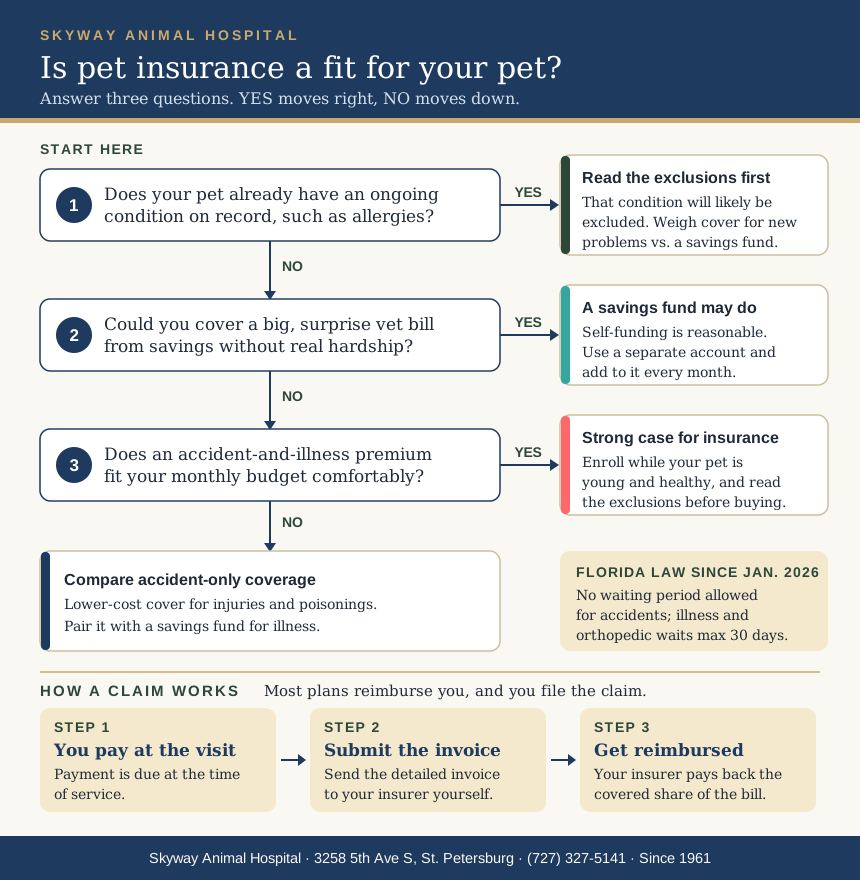
Pet insurance is worth it when a big, unplanned bill would change which care you could say yes to. Premiums have to cover every claim plus the insurer's costs, so insurance isn't a way to spend less on average. It turns an unpredictable expense into a predictable monthly one.
It tends to make the most sense when:
- You're starting with a puppy or kitten. Nothing is on record yet, so very little can be excluded as pre-existing. Deciding around your first puppy and kitten visits is the biggest factor in how much value you get.
- A large bill would force a hard choice. If surgery or a sudden illness would mean choosing between treatment and rent, a policy protects that decision.
- Your pet's breed has known inherited problems. Hereditary and congenital conditions are where policies differ most, so read those exclusions first.
Self-funding can be reasonable if you have, or can steadily build, savings you'd spend on your pet, or if your older pet's likely problems are already documented.
One St. Pete wrinkle is skin allergies. Florida's warm, humid climate keeps allergens active year-round, and environmental allergies are typically managed long-term rather than cured. Ear infections, skin conditions and allergies rank among the most common conditions in insured dogs across North America, according to the North American Pet Health Insurance Association. Once allergies are on record before coverage starts, expect them to be excluded.
The alternatives. A separate savings account with an automatic monthly transfer works if you start early and leave it alone. For bills that arrive sooner, we accept CareCredit, a health care credit card, and Scratchpay payment plans. Read CareCredit's promotional terms closely: on deferred-interest offers, if the promotional balance isn't paid off by the deadline, the accrued interest is added to your account.
How Does Pet Insurance Work at the Vet?
Most pet insurance works by reimbursement: you pay the clinic, send your insurer the invoice, and the insurer pays you back for the covered share. That's how it works at Skyway.
- You pay at checkout. Payment is due at the time of service, by cash, credit or debit card, or CareCredit.
- You submit the detailed invoice we provide to your insurer, the way your policy directs. Some insurers also want medical records with a first claim.
- Your insurer reimburses you after subtracting any deductible still owed and applying your reimbursement percentage and limits.
Because you pay first, even a generous plan means fronting the full bill until the claim pays. For planned procedures, ask us for a written estimate you can share with your insurer.
Which Policy Terms Decide Whether It Pays Off?
Seven terms decide whether a policy pays off, and two policies with similar premiums can differ on all of them.
- Deductible. What you pay before reimbursement starts, either yearly or per incident. A higher deductible lowers the premium.
- Reimbursement percentage. The share of a covered bill the insurer pays after the deductible. Plans commonly offer 70, 80 or 90 percent. Ask what it's applied to: your actual invoice, a benefit schedule, or "usual and customary" fees.
- Annual limit. The most the policy pays in a policy year. Some plans also cap payouts per incident or per lifetime.
- Waiting period. The stretch after enrollment before coverage begins.
- Pre-existing condition exclusions. Anything a veterinarian advised on or treated, or that showed signs, before coverage began can be excluded.
- Accident-only vs. accident-and-illness. Accident-only plans cover injuries such as swallowed objects, cuts and poisonings, and cost less. Accident-and-illness adds infections, digestive illness, cancer and more.
- Wellness add-ons. Optional coverage for routine care such as vaccines and exams. Treat it as a budgeting tool rather than protection against big bills.
Premiums are priced partly on your pet's age, breed and where you live, and they generally climb as pets get older.
What Florida's new law changed. Florida's Pet Insurance Act (section 627.71545, Florida Statutes), in effect since January 1, 2026, applies to policies sold here:
- New policies can't impose a waiting period for accidents, and illness or orthopedic waits can't exceed 30 days.
- The waiting period must be waivable with a veterinary exam, paid by you unless the policy says otherwise.
- You get 30 days to return a new policy for a refund if you haven't filed a claim.
- A condition the policy has covered can't become pre-existing at renewal.
- Wellness programs sold alongside insurance must be optional, priced separately, and never marketed as insurance.
Your Pet Insurance Checklist
Before you buy, do these seven things.
- Decide early, ideally at the puppy or kitten stage.
- Read the sample policy, not just the quote page. Florida requires insurers to disclose whether they exclude chronic, congenital, hereditary and pre-existing conditions.
- Ask whether premiums rise with your pet's age or your claims history. Florida insurers must tell you.
- Confirm you can use any licensed veterinarian, including an after-hours emergency hospital.
- Write down the date coverage begins, and don't assume an illness in the first weeks is covered.
- Keep every detailed invoice and submit claims promptly. Check for a filing deadline.
- Build a savings fund anyway for the deductible and your share of each bill.
Frequently Asked Questions
Does pet insurance cover pre-existing conditions?
Usually not. Most insurers exclude conditions a veterinarian advised on or treated, or that showed signs, before coverage began or during the waiting period. Some treat a cured condition differently from a chronic one like allergies, so ask. Under Florida law, the insurer must disclose these exclusions and carries the burden of proving one applies to your claim.
Is pet insurance worth it for an older dog or cat?
It can be, but the math is harder. Premiums generally rise with age, some insurers limit enrollment for older pets, and the likeliest problems may already be excluded. For a healthy senior, coverage for new accidents and illnesses can still help. For a senior with several documented conditions, a savings fund may fit better.
Does Skyway Animal Hospital accept pet insurance?
Yes. Skyway accepts all pet insurance plans. Payment is due at the time of service, and we provide a detailed invoice you can submit to your insurance company for reimbursement. If you're comparing policies, the terms above matter more than the brand name.
Pet insurance solves one specific problem: the large bill you didn't see coming. The best time to decide is before you need it.
Questions about what care your dog or cat will likely need at each life stage? Call us at (727) 327-5141. Two more worth reading: what vet care actually costs in St. Pete and how to plan for an after-hours emergency.
Written by the Skyway Animal Hospital team. Skyway has served Pinellas County pet families since 1961.