Holiday Hazards for Cats: Lilies, Tinsel and the Open Front Door
Skyway Animal Hospital
Veterinary Team
The holiday dangers that hurt cats most aren't on the dinner plate. True lilies, a staple of holiday bouquets, can cause kidney failure in a cat that chews a leaf or licks pollen off its fur, so they shouldn't be in a home with a cat at all. Tinsel and ribbon can tangle in the intestines and may need surgery. And a house full of guests means a front door that keeps opening. If your cat gets into a lily, call a veterinarian right away, because treatment works best when it starts early.
From Thanksgiving through New Year's, the house fills with flowers, a tree, packages and guests. Here's what to watch for, plus our holiday hours.
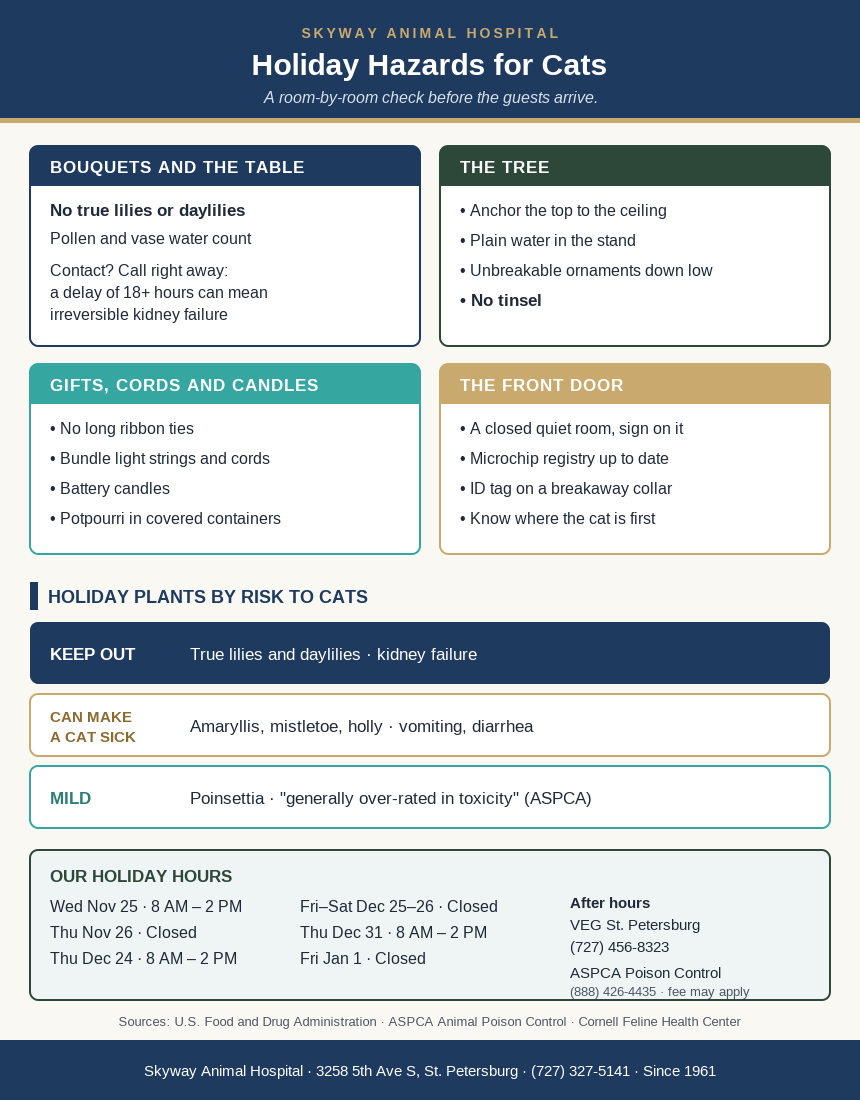
Lilies: The One Flower to Keep Out of the House
If you change one thing this season, make it this: no true lilies in a home with a cat.
According to the FDA, the entire lily plant is toxic to cats: the stem, leaves, flowers, pollen and even the water in the vase. A cat doesn't have to eat much: the FDA says licking a few pollen grains off its fur while grooming, or drinking the vase water, can cause fatal kidney failure. Early signs are decreased activity, drooling, vomiting and loss of appetite, starting 0 to 12 hours after exposure, and the FDA warns that if treatment is delayed by 18 hours or more, the kidney failure is generally irreversible. Dogs that nibble a lily usually get only a minor stomach upset.
The lilies to keep out are the true lilies, such as Easter, tiger, Asiatic, Oriental, Stargazer and Rubrum lilies, and daylilies, all on the FDA's list of lilies dangerous to cats. Peace lilies and calla lilies aren't true lilies; they cause mouth irritation rather than kidney damage. Lily of the valley is a separate problem: it affects heart rhythm and is dangerous to dogs as well. When a bouquet arrives, check what's in it, and if you're unsure, keep it in a room the cat can't reach.
The other holiday plants are milder. The ASPCA calls poinsettia "generally over-rated in toxicity": expect mouth irritation and maybe some vomiting. Holly can cause vomiting, diarrhea and listlessness, mistletoe vomiting and diarrhea (the FDA says severe poisoning is uncommon), and amaryllis vomiting, drooling, belly pain and tremors, per the ASPCA. None of them is a cat snack, but none is in a lily's class. For chocolate, xylitol and the rest of the pantry, see our Halloween safety guide.
If your cat has touched or chewed a lily, don't wait for symptoms. Call us during our hours at (727) 327-5141. After hours, call VEG St. Petersburg at (727) 456-8323 or the ASPCA Animal Poison Control Center at (888) 426-4435 (a consultation fee may apply). Bring the plant or a photo of it.
Tinsel, Ribbon and Anything Else That Dangles
Cats play with string, and the holidays bring plenty of it. Cornell University's Feline Health Center explains why tinsel is dangerous: if a strand wraps around the base of the tongue before the rest is swallowed, it can act like a piano wire as the intestines move and cut through them, which Cornell calls "very life-threatening." The ASPCA adds that swallowed tinsel can cause severe vomiting, a blocked digestive tract and dehydration, and may need surgery. Ribbon and yarn work the same way.
What helps:
- Skip tinsel in a home with a cat.
- Wrap gifts without long ribbon ties, especially packages that sit under the tree, as Cornell advises.
- If you see a string coming from your cat's mouth or rear end, don't pull it. The American College of Veterinary Surgeons warns that a string anchored in the mouth must never be pulled, because it can cut through the intestine. Call us instead.
Cornell's rule of thumb is a good one for the whole season: if it's not safe for a child, it's not safe for a cat.
The Tree, the Cords and the Candles
To most cats, a tree is a climbing frame with toys on it. Cornell's suggestions:
- Anchor it. Cornell suggests tying the top to a cup hook in the ceiling with wire or string so it can't come down.
- Use plain water in the stand, with nothing added.
- Hang unbreakable ornaments (cloth, wood, straw) on the lower branches, tied on with cloth loops instead of wire hooks.
- Bundle the cords. Chewing on light strings and plugged-in cords is dangerous, so tie them up or run them through a cord protector.
Candles and scented oils are the other big one. Cats are drawn to flickering light and to the taste of many essential oils, Cornell notes, and the result can be burned paws and tails from swatting at a flame, or chemical burns on the tongue from lapping liquid potpourri. Battery candles and containers with lids solve both.
Guests and the Open Front Door
For a cat, the riskiest part of a holiday party is often the front door.
Cornell's advice for Thanksgiving visits is to be mindful of where your cat is when you open the door to welcome guests, because some cats will slip out given the chance. Before the doorbell starts:
- Set up a quiet room with litter, water, food and a bed, close the door, and put a sign on it. Most cats would rather skip the party anyway.
- Check the microchip registration. The chip is only as useful as the contact details on file with its registry. In a 2009 study of 53 US shelters published in the Journal of the American Veterinary Medical Association, microchipped cats went home to their owners 38.5% of the time, against 1.8% for stray cats overall. If your cat isn't chipped yet, microchipping is part of our wellness care.
- Add a breakaway collar with an ID tag if your cat will wear one.
Your Holiday Cat Checklist
Run through it before the first guest arrives.
- No true lilies or daylilies in the house, including in gifted bouquets.
- No tinsel, and no long ribbon on packages.
- Anchor the tree and use plain water in the stand.
- Bundle or cover light strings and cords.
- Battery candles only, and covered potpourri.
- A closed quiet room for party days, with a sign on the door.
- Microchip registry up to date, with a phone number that reaches you.
- Save three numbers: Skyway (727) 327-5141, VEG St. Petersburg (727) 456-8323, and ASPCA Animal Poison Control (888) 426-4435.
Our holiday hours: Wednesday, November 25, 8 AM to 2 PM · Thanksgiving Day, Thursday, November 26, closed · Christmas Eve, Thursday, December 24, 8 AM to 2 PM · Friday and Saturday, December 25 and 26, closed · New Year's Eve, Thursday, December 31, 8 AM to 2 PM · New Year's Day, Friday, January 1, closed. Otherwise we're open Monday through Friday 8 to 6 and Saturday 8 to noon.
Frequently Asked Questions
Are lilies poisonous to cats?
Yes. True lilies and daylilies are among the most dangerous plants for cats: every part, including the pollen and the vase water, can cause kidney failure. Peace lilies and calla lilies cause mouth irritation instead. If your cat had any contact with a true lily, call a veterinarian right away rather than waiting for signs.
Are poinsettias poisonous to cats?
Only mildly. The ASPCA calls poinsettia "generally over-rated in toxicity"; a cat that chews the leaves may drool or vomit. It's still best kept out of reach, but it's not in the same category as a lily.
What should I do if my cat swallowed tinsel or ribbon?
Call us during our hours, or VEG St. Petersburg after hours, and don't pull on any string you can see. Swallowed tinsel and ribbon can block or cut the intestines and sometimes need surgery. Vomiting, not eating or hiding after a string toy goes missing are reasons to call.
Most holiday trouble with cats comes down to a few things a cat can reach. If you're not sure whether something your cat got into is a problem, call us at (727) 327-5141. Two more worth reading: the feline viral diseases every cat owner should know about and why indoor cats still need annual exams.
Written by the Skyway Animal Hospital team. Skyway has served Pinellas County pet families since 1961.